Chemical Tanker Company Singapore: Understanding Fleet, Services, and Shipping Requirements
For chemical manufacturers, suppliers, traders, and procurement teams, transporting liquid chemical products internationally requires more than arranging a vessel. Cargo characteristics, vessel suitability, route planning, documentation, storage, tracking, and delivery coordination all influence how smoothly a shipment moves.
Singapore is an important maritime and logistics hub in Asia, making it a relevant location for companies evaluating international chemical transportation services. A chemical tanker company Singapore can support businesses by coordinating maritime transportation alongside related logistics activities, depending on the provider's capabilities.
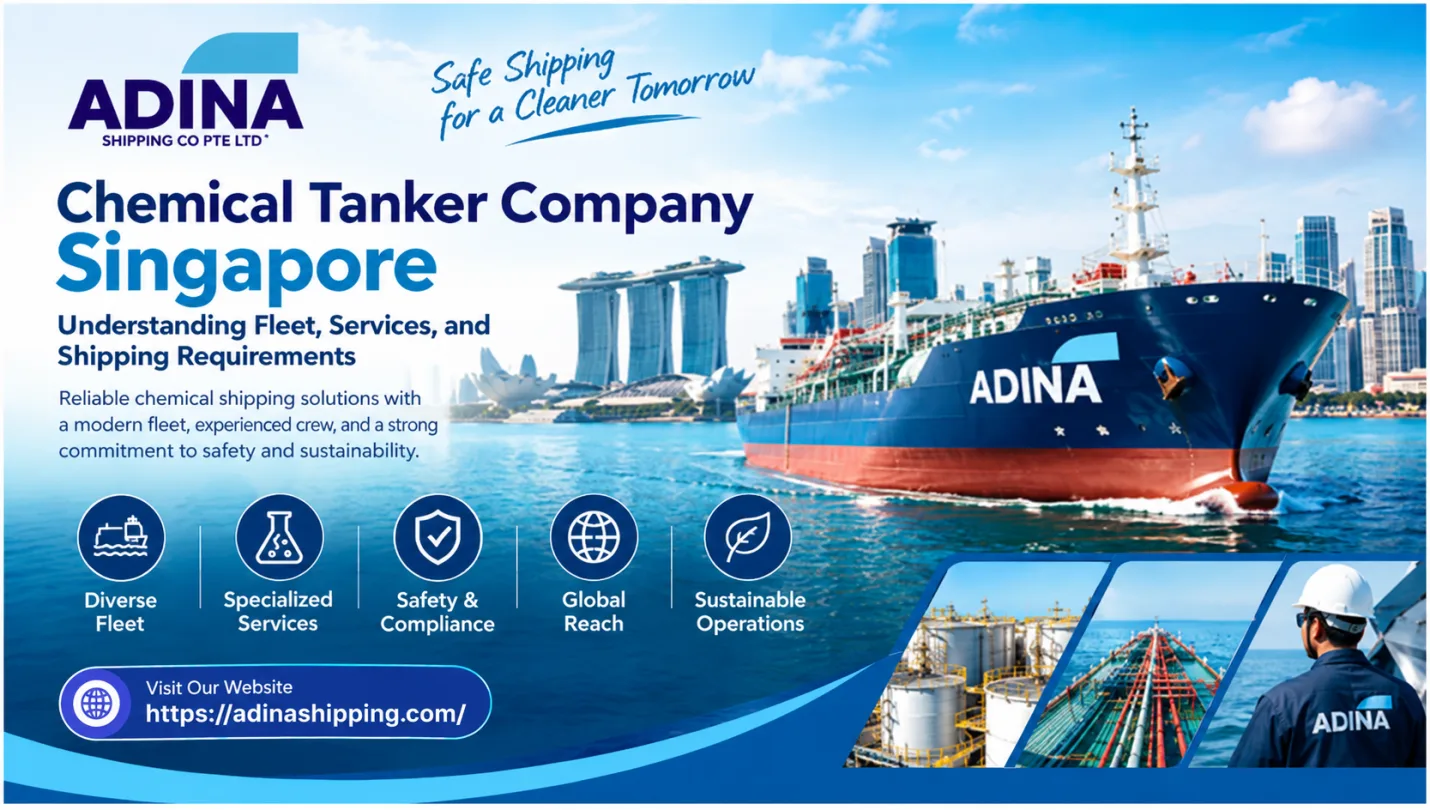
ADINA SHIPPING presents its services around fleet services, specialized chemical carriers, real-time tracking, tank storage, and logistics management. Its website identifies Jurong, Singapore as its location and lists connections across major regions and ports.
What Does a Chemical Tanker Company in Singapore Do?
A chemical tanker company Singapore provides or coordinates maritime transportation for liquid chemical and related products, helping businesses move cargo between designated ports while managing vessel, scheduling, documentation, and logistics requirements.
The exact services vary between providers. Depending on the business model, a provider may offer:
- Chemical or product tanker transportation
- Vessel booking and scheduling
- Cargo and route planning
- Shipment tracking
- Port coordination
- Documentation support
- Tank storage
- Temperature-controlled storage options
- Intermodal or related logistics services
The key point is that chemical transportation is part of a broader supply chain. Businesses need to consider how the vessel movement connects with storage, inventory planning, port operations, and final delivery.
Why Singapore Matters for Chemical Tanker Shipping
Singapore's geographic position makes it an important connection point for maritime trade between Asia and other international markets. For companies moving chemical products through international supply chains, access to established maritime infrastructure and connections can be an important consideration.
A Singapore-based logistics provider may also coordinate shipments involving multiple regions rather than focusing exclusively on domestic transportation.
ADINA SHIPPING lists Singapore within its Asia-Pacific network, alongside locations such as Hong Kong, Shanghai, Tokyo, Sydney, and Mumbai. Its stated global coverage also includes ports in Europe, the Americas, and the Middle East and Africa.
For procurement and logistics teams, this type of network can be relevant when assessing whether a provider can support a shipment beyond the initial Singapore port.
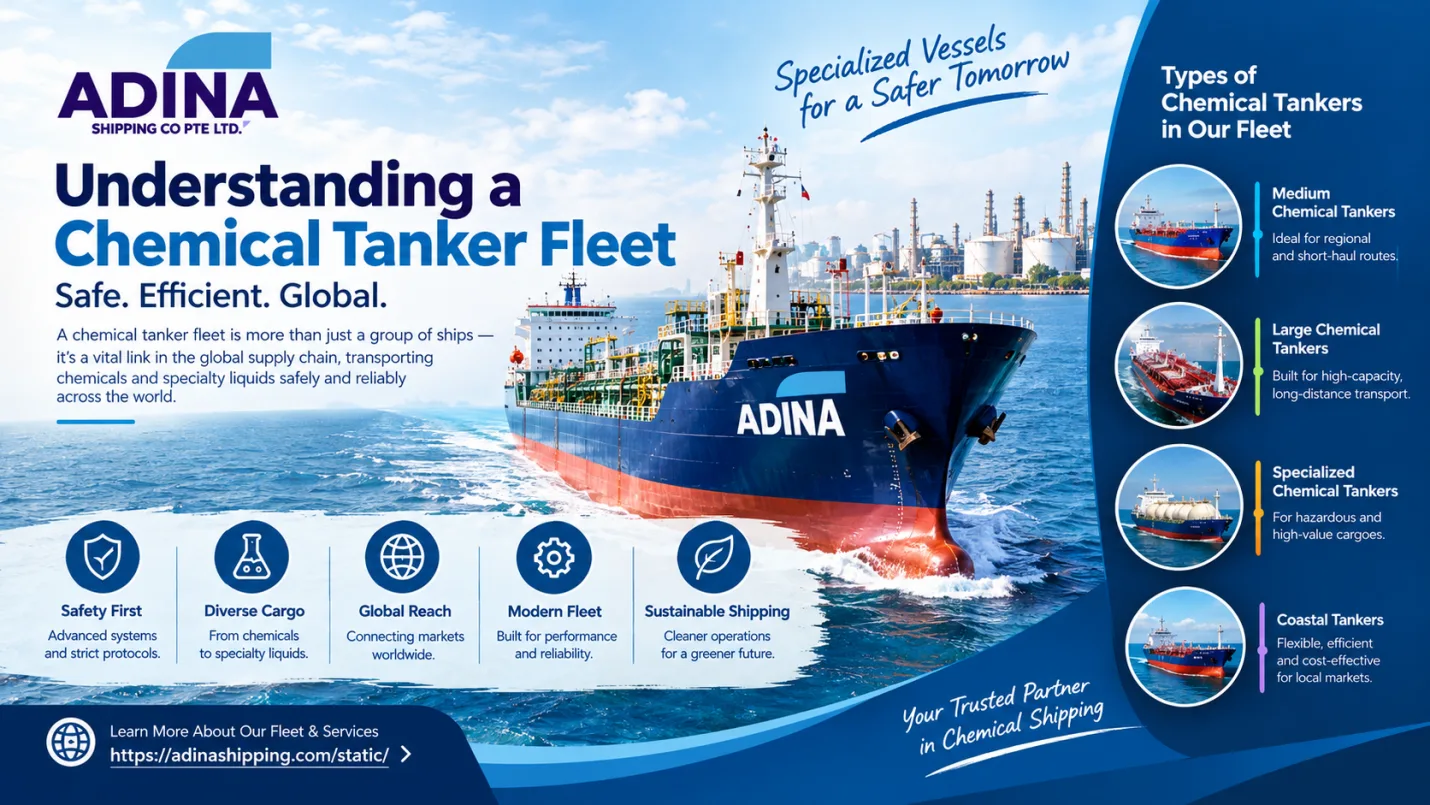
Understanding a Chemical Tanker Fleet
A chemical tanker fleet refers to the collection of vessels available to a transportation provider for moving liquid products. Fleet composition matters because different shipments can have different requirements.
When evaluating a fleet, businesses should consider factors such as:
- Vessel type: Different vessels are designed for different cargo and transportation requirements.
- Cargo compatibility: The vessel and its cargo-handling arrangements need to be appropriate for the product being transported.
- Capacity: Shipment volume can influence which vessel is practical.
- Route requirements: Port restrictions, sailing distances, and operational conditions may affect vessel selection.
- Availability: A suitable vessel must also be available for the required shipping window.
- Operational specifications: Businesses may need information about vessel characteristics before confirming transportation.
ADINA SHIPPING publicly displays vessels in its fleet with information such as vessel name, IMO number, ship type, flag, and year built. Its fleet page also provides live AIS-position tracking for listed vessels.
Importantly, businesses should not assume that every vessel in a provider's broader fleet is suitable for every chemical cargo. Vessel selection should be based on the specific product, quantity, route, and operational requirements.
What to Look for in a Chemical Tanker Company Singapore
Selecting a provider should involve more than comparing transportation prices. Procurement and logistics teams can use several practical criteria.
1. Fleet Capabilities
Ask what vessel types are available and whether the provider can accommodate the required shipment volume and route.
2. Chemical Cargo Handling Experience
Clarify whether the provider has experience with the specific category of chemical product being transported and what cargo information is required before booking.
3. Vessel Suitability
Cargo compatibility, capacity, route requirements, and operational specifications should be reviewed before transportation is confirmed.
4. Global Port Coverage
For international shipments, check whether the provider supports the relevant origin and destination ports or can coordinate the required logistics.
5. Shipment Tracking
Tracking can give logistics teams better visibility into vessel movements and help them coordinate downstream activities.
6. Safety and Operational Procedures
Ask the provider to explain the procedures applicable to the cargo and transportation operation rather than relying on general safety statements.
7. Documentation and Compliance Support
Chemical transportation involves documentation and regulatory considerations. Businesses should clarify which documents they must provide and what support the logistics provider offers.
8. Communication and Customer Support
Clear communication matters when schedules change. A defined contact point and regular shipment updates can make coordination easier.
ADINA SHIPPING states that its logistics services include comprehensive documentation and dedicated account management, while its transportation services include maritime shipping and GPS tracking.
How Fleet Tracking Improves Chemical Shipping Visibility
Shipment visibility is increasingly important for supply chain teams. Tracking information can help businesses understand where a vessel is during transit and coordinate activities around its expected arrival.
For example, a procurement team may need to coordinate inventory levels before a shipment arrives. A receiving facility may need to prepare storage capacity. A customer may also require an updated delivery estimate.
ADINA SHIPPING's website provides live vessel tracking and states that its fleet service includes real-time tracking. Its fleet page allows users to view public AIS positions for listed vessels.
Tracking does not eliminate schedule uncertainty, but timely information can help logistics teams respond more effectively when estimated arrival times or vessel movements change.
Chemical Tanker Shipping: From Booking to Delivery
A typical shipment can be viewed as a sequence of coordinated steps:
- Shipment requirements are shared — The shipper provides product information, quantity, origin, destination, and timing requirements.
- Cargo and route requirements are reviewed — The provider assesses the transportation requirements.
- Suitable transportation arrangements are considered — Vessel availability, capacity, cargo suitability, and route requirements are reviewed.
- Documentation and scheduling are coordinated — Required information, port arrangements, and shipment schedules are organized.
- Cargo is transported — The shipment moves according to the agreed transportation plan.
- Shipment progress is monitored — Tracking and regular updates provide visibility during transit.
- Delivery and related logistics are completed — Arrival, receiving, storage, and any connected logistics activities are coordinated.
ADINA's booking page, for example, asks for information including vessel type, product type, quantity, departure and arrival ports, and desired departure date when submitting a vessel booking request.
Questions to Ask Before Choosing a Chemical Tanker Company
Before engaging a provider, procurement teams can ask:
- What type of chemical cargoes can you handle?
- What vessels are available for the required route?
- How large is your chemical tanker fleet?
- Which international ports do you serve?
- Do you provide vessel or shipment tracking?
- How frequently are shipment updates communicated?
- What documentation is required from the shipper?
- Do you provide tank storage or additional logistics services?
- How is vessel suitability assessed for a particular cargo?
- Who is the main operational contact during the shipment?
These questions help turn a general supplier search into a more structured logistics evaluation.
Frequently Asked Questions
What is a chemical tanker company?
A chemical tanker company provides or coordinates maritime transportation for liquid chemical products. Depending on the provider, services may also include vessel booking, tracking, storage, documentation, and broader logistics management.
Why choose a chemical tanker company in Singapore?
Singapore is a major maritime location in Asia with connections to international shipping routes. A chemical tanker company Singapore can therefore be relevant to businesses coordinating regional or international chemical supply chains.
What is a chemical tanker fleet?
A chemical tanker fleet is the group of vessels operated, managed, or made available by a transportation provider for relevant cargo movements. Fleet composition can vary by vessel type, capacity, specifications, and intended cargo.
What factors determine which chemical tanker is suitable for a shipment?
Important factors can include cargo characteristics, quantity, required capacity, route, port requirements, vessel specifications, scheduling, and other operational conditions. The final choice should be based on the shipment's specific requirements.
How can businesses track chemical tanker shipments?
Depending on the provider, businesses may receive vessel-position information through AIS-based tracking or other shipment-monitoring systems. Regular logistics updates can also help teams coordinate receiving, inventory, and delivery activities.
Conclusion
Choosing a chemical tanker company Singapore involves evaluating the complete transportation process rather than looking only at the vessel or freight cost. Fleet capabilities, cargo compatibility, route coverage, documentation, tracking, storage, communication, and logistics coordination can all affect how effectively a shipment is managed.
A capable chemical tanker fleet is useful only when its vessels align with the requirements of the cargo and route. Businesses should therefore provide accurate shipment information and ask detailed questions before confirming transportation arrangements.
For companies researching international chemical logistics, reviewing a provider's documented services, fleet information, tracking capabilities, storage options, and global coverage can provide a clearer basis for evaluating whether its services match a particular supply-chain requirement. ADINA SHIPPING presents these capabilities across its fleet, logistics, tracking, and storage services, with its location identified in Jurong, Singapore.
Explore Your Chemical Logistics Options — Contact Us.